Using AI to acquire knowledge has become one of my favorite uses for this technology.
It has been especially helpful in learning new languages - in my case, German. From the beginning of that journey, I've had an amazing private tutor - someone I have no intention of replacing with AI - and we meet twice a week.
Between our lessons, I like to challenge myself with projects that are slightly above my current level. Recently, that has meant reading Heidegger in German.
One of the ways AI helps me most is in how I prepare for those lessons. I can discuss passages, test interpretations, and refine my questions before class. But the final source of truth is always my teacher, not the AI. The goal isn't to replace the conversation - it's to make the conversation better.
Heidegger was my first choice for several reasons, but he's not exactly an easy read.
There are at least three layers of difficulty:
- There are many words, including everyday German words, that I simply don't know.
- Some are Heidegger-specific terms, philosophical concepts, or older expressions that are no longer in common use.
- At my level, I often can't tell which is which.
I'm using AI to help me make that distinction.
My workflow is intentionally slow. I read a paragraph without stopping. I highlight words, phrases, or ideas I don't fully understand. I take notes by hand. Then I take a photo of the page and ask an LLM to help classify what I found:
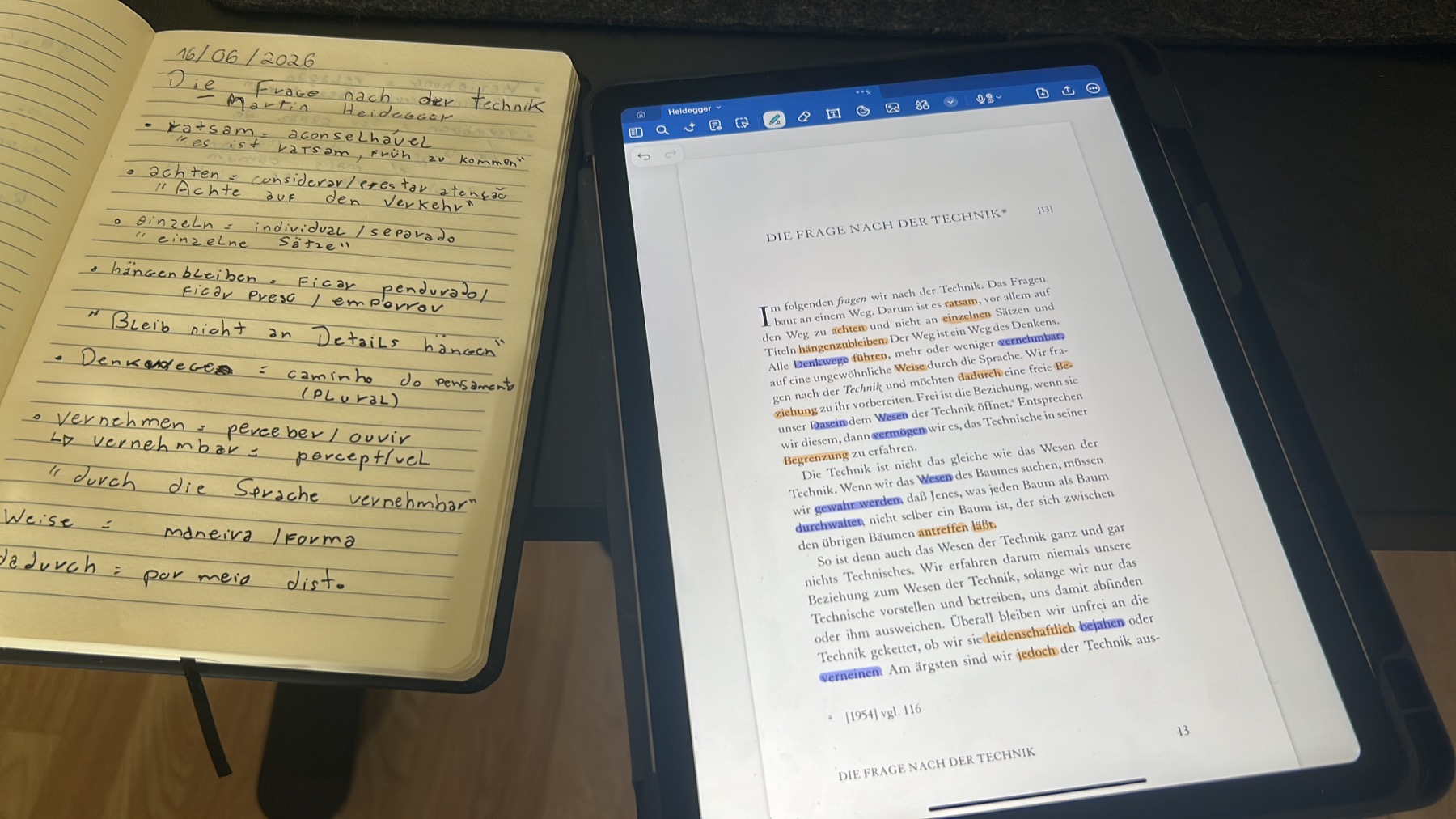
🟨 Yellow = everyday vocabulary.
🟪 Purple = Heidegger or older language.
Then I go back and read again.
I could automate almost everything. I could build an app, generate dashboards, track progress, gamify the experience, and create an entire learning system around it.
I don't want to.
Steve Jobs once described computers as bicycles for the mind. I think the same is true of AI.
On a bicycle, you set the pace.
Here, slowness is valuable. It gives my brain time to process what I'm reading.
In that sense, this feels very close to the central idea of Heidegger's The Question Concerning Technology. The problem is not technology itself. The danger is allowing our relationship with the world to be shaped entirely by efficiency, optimization, and extraction.
Sometimes you don't want the fastest route.
Sometimes you want to ride slowly and pay attention to the world around you.
After all, attention is all you need.